Scenario 2 for Salmon: Cut Through the Spectacle, Fund the Living Economy
By Dr Emily Samuels Ballantyne
Not another report.
Not another shouting match.
A cold room humming at dawn.
A market stall set before rain.
Clear numbers on a public dashboard.
A harbour allowed to breathe.
Food moving, money circulating, hands employed.
This is how a place changes.
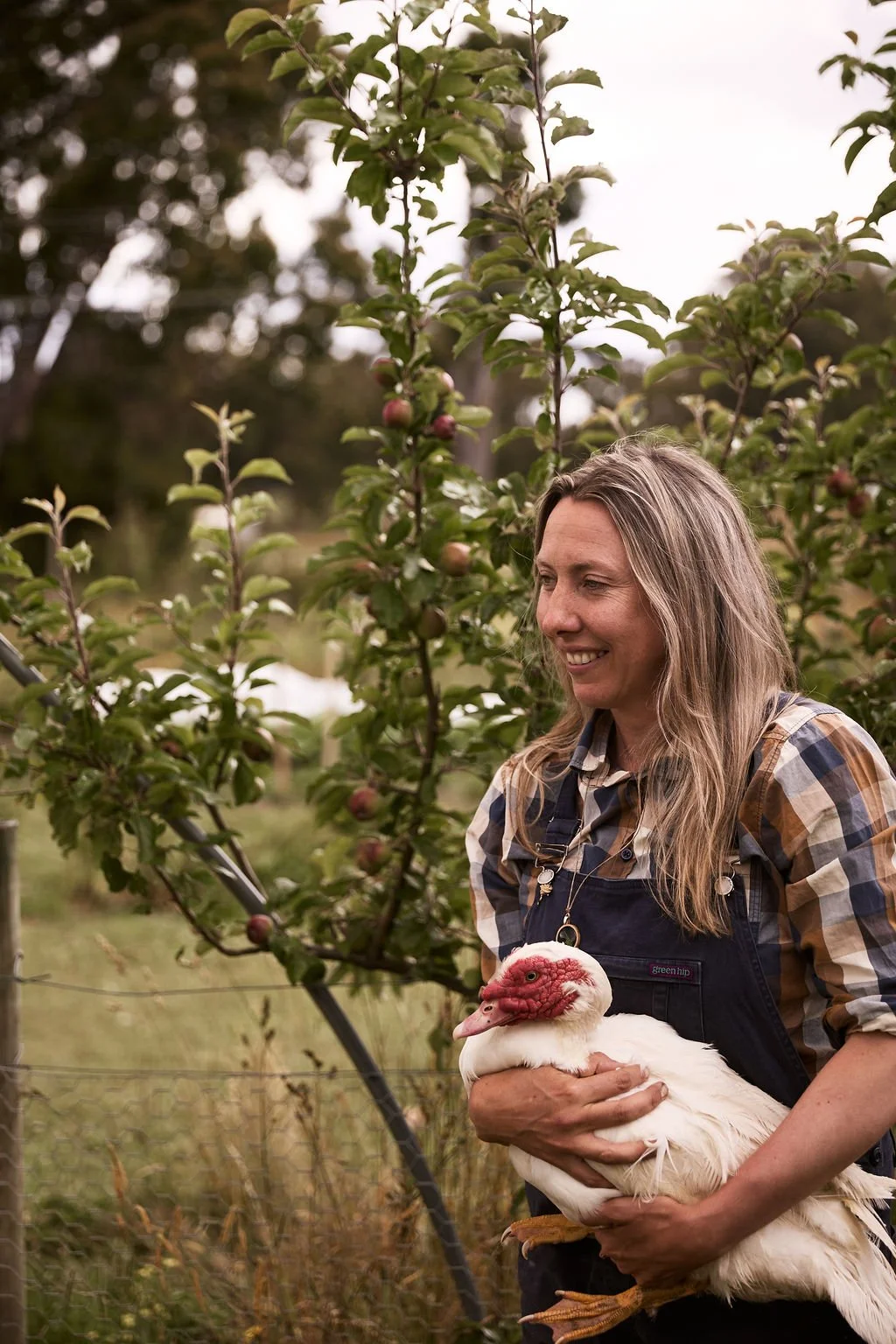
GROW SMALL, FEED ALL: endorsed by Simon the duck.
It’s time to back what works: local growers and fishers, real markets, cold rooms and food hubs, local procurement for schools and hospitals, clear water limits, and thousands of practical jobs that keep money circulating in Tasmania. Photography by Ness Vandeburgh
Tasmania’s salmon debate has become a spectacle: loud, binary, expensive, and strangely repetitive. We cycle through outrage and defence, inquiry and counter claim, media storm and consultant document, while the deeper question remains largely unanswered: What is Tasmania’s practical plan for a resilient protein and food economy in a warming century, one that protects waterways and livelihoods at the same time?
The trouble is that our public system keeps rewarding paper output and conflict performance, while underfunding the operational work that would actually change conditions. We have become very capable at managing controversy, and much less capable at designing a transition.
Scenario 2 for salmon begins by refusing the false choice Tasmania has been offered for years: defend a brittle model at all costs, or perpetually express outrage about it. Neither position rebuilds a food economy, restores trust or protects water early enough. Scenario 2 is the third option: a measurable transition that shifts Tasmania from concentrated risk to distributed resilience by investing in local provisioning, diversified protein, and clear governance. This allows us to stop reacting to crises and start building conditions.
The numbers that break the spell
Salmon has political gravity because it is economically significant, supporting about 6,935 jobs in 2022-23 and contributing roughly $1.154 billion in gross value added to the Tasmanian economy. That scale matters, and it should be treated seriously rather than weaponised in a culture war.
But another set of numbers should matter just as much, and they rarely lead the headlines. Tasmania’s Agri Food ScoreCard estimates $5.39 billion in total food spend across retail and food service, and $1.97 billion of that spend is met by food sourced from outside the state, made up of $1.84 billion in net interstate purchases plus $134 million in overseas imports. That means roughly 36.5 percent of what Tasmanians buy to eat by value comes from outside Tasmania. At the same time, the ScoreCard notes Tasmania produces about 11 times more food than Tasmanians consume.
Put those facts together and the problem becomes plain. Tasmania exports abundance, yet still leaks close to $2 billion a year out of the local economy to feed itself day to day. If even a meaningful portion of that spend were grown, processed, stored, transported, marketed, and cooked through Tasmanian hands and Tasmanian enterprises, it would not only lift farmers but create whole chains of local work and value: packing sheds and cool rooms, small processors and butchers, market operators and delivery routes, apprenticeships and regional logistics, keeping money circulating through towns instead of draining quietly offshore and interstate. Producing lots of food doesn’t automatically mean Tasmanians are well fed or better off, if the profits, processing, supply chains, and contracts are set up so the value keeps leaving the state.
This is where Scenario 2 properly begins, because the goal is not simply to argue about salmon pens. The goal is to build an economy that can carry workers, communities, and ecosystems without repeatedly hitting crisis.
The crisis ledger that we rarely see published
We also need an honest accounting of what the spectacle costs. Routine salmon regulation is now largely cost recovered through a levy. Tasmania estimates raising around $9.6 million in 2024-25 to cover salmon management, and a cost recovery program reported total management costs of around $10.17 million in 2023-24.
But consequence management still costs the public real money, especially around Macquarie Harbour. FOI material summarised publicly cited $37.5 million in Commonwealth funding since June 2022 for oxygenation and related measures including monitoring and compliance, with Tasmania also committing $5.13 million since 2014 in that stream. These are not the only costs, and public announcements across different years can overlap, which is exactly the point: when we do not keep a clear, consolidated crisis ledger, the community is asked to argue in the dark, and politics is tempted to keep paying for conflict and fallout management rather than funding the redesign that prevents crisis in the first place. Crisis management is costing the state millions.
Scenario 2 in operational terms, with the economic case
Scenario 2 is not anti salmon. It promotes resilience and replaces the salmon pen spectacle with measurable jobs and a food economy plan built on the Grow Small Feed All policy architecture and Tasmania’s own food economy leakage data. Let's revisit the hard numbers: Tasmania’s Agri Food ScoreCard estimates $5.39b total food spend, with $1.97b supplied from outside the state ($1.84b interstate plus $134m overseas), meaning about 36.5% of what Tasmanians buy to eat by value comes from outside Tasmania, even though Tasmania produces about 11x more food than residents consume. The opportunity is simple: redirect even $1.0b per year of that $1.97b leakage into Tasmanian supply chains over the next decade and you create a new employment base at the scale that makes salmon politically untouchable.
Now connect that to Grow Small Feed All: The proposal is $600m over 10 years, with $450m as renewal grants at $33k per farm per year, supporting about 1,360 small market gardens, and $150m for the enabling layer. This layer ensures reliable supply, procurement capability, coordinators, agronomy support, auditing, monitoring and evaluation, and market coordination. Over the ten year program, participating Grow Small Feed All farms, commit to selling a defined, measurable share of their produce to Tasmanian outlets, local markets, food hubs, and institutional buyers. This ensures the public investment translates into local supply, local circulation, and reliable procurement rather than export only. Those numbers matter because they turn local food from a sentiment into a new market and operating system. Jobs logicTo make the economic case properly, I will forecast it like infrastructure and an operationl strategy, not like a slogan. If Tasmania redirects $1.0b per year of food purchases into Tasmanian supply chains over the next decade, the question becomes how much of that spending is retained as Tasmanian wages and jobs once we build the missing middle.
In a centralised import chain, the local wage share is low, but in a locally processed, locally distributed system it rises because more steps happen here: packing, cold storage, processing, logistics, market operations, and institutional catering. If the local wage share falls within a realistic 15-30% range depending on how strongly we build those steps, that equates to $150m-$300m per year in Tasmanian wages. At an all in labour cost of $80k–$110k per full time role, that supports roughly 1,300-3,300 FTE directly across the chain, with a wider job ecology on top through part time roles, micro enterprises, and tourism and hospitality flow ons. This is why Scenario 2 is economically serious: the policy design changes the parameters so more value stays on the island, for the highest good of communities, waterways, and the living future we are still able to choose.This is the core case: salmon is vulnerable because open net pens concentrate ecological and political risk in a changing climate, while a diversified local provisioning economy spreads risk, spreads ownership, and spreads jobs across many enterprises and regions. Scenario 2 does not trade jobs for water. It builds more stable jobs by aligning the economy with living limits, and gives Tasmania a practical way to move beyond spectacle toward a thriving living cultural landscape.
What government and communities actually do in scenario 2
If Tasmania is serious, we stop treating implementation as a footnote. Local government designates regular market sites as essential civic infrastructure and funds the practical basics: facilitation on site, shelter, lighting, water access, waste, signage, coordination, and consistent scheduling so producers and shoppers can rely on it. Regions secure premises for shared cold storage and small processing so growers can hold quality, aggregate volume, and add value locally rather than losing margin to freight and intermediaries. Procurement officers in schools, hospitals, aged care and government facilities are mandated and supported to shift a defined portion of purchasing into Tasmanian supply through simple contracts that small producers can actually meet.
Food hubs aggregate, grade, chill and distribute, not as pilots that never graduate, but as ongoing institutions with cooperative governance, clear service fees, and transparent reporting. Workforce pathways train market managers, logistics coordinators, quality assurance roles, cooperative organisers, and small enterprise builders, so the work becomes real jobs, real skills, and real livelihoods rather than endless consultation. The State provides an enabling platform that makes local action easier: standard procurement contract templates, shared compliance tools, freight coordination support, and micro grants for refrigeration and packing upgrades, with straightforward finance pathways for cooperatives and grounded small enterprises to access capital without being swallowed by paperwork.
Tasmania would not be moving alone in this. In Canada, the federal government has committed to ending open net pen salmon aquaculture in coastal British Columbia by 30 June 2029, signalling a move away from high risk pen farming in coastal waters. But the Canadian case also highlights a deeper challenge: the retreat from one damaging model does not automatically generate a new economic reality. What remains under-developed is the public imagination, policy architecture, and investment needed to build a genuinely regenerative food economy in its place. For Tasmania, this is the real work before us. The opportunity is not only to move beyond ecological harm, but to design a richer regional economy grounded in restoration, small farm productivity, local processing, and long term food resilience. Scenario 2 matters because it begins to name that possibility.
We must be honest about the government's business model underneath the spectacle, because we already spend millions each year across local and state government on salaries and programs whose main outputs are documents, consultations, and compliance theatre rather than food actually moving through local hands. This means the real question is not whether we can afford to operationalise life, but whether we can justify continuing to fund paperwork as if it were progress while the provisioning system remains underbuilt.
The investment container
The Grow Small Feed All offers a practical policy container: $600 million over 10 years, with $450 million directed to long term renewal grants for small farms and $150 million directed to coordination and assurance so the system can function, including procurement capability, regional coordinators, agronomist support, monitoring and evaluation, auditing, and market coordination. It is not a silver bullet but it is a serious start, and it is proportionate to the size of the leakage we can capture and the jobs we can create. It is also anchored in a clear revenue opportunity. The ScoreCard shows Tasmania spends about $1.97 billion annually on food sourced from outside the state. Shifting just $1.0 billion of that spend into Tasmanian supply chains gives the program a real economic engine, turning public investment into ongoing local circulation.
Grow Small, "Feed All" is an equality design, not a slogan.
“Feed All” refers to equality, and it must be designed into the system from the start, otherwise local food becomes a lifestyle niche. That means the centre of gravity cannot be gentrified farmers markets; It has to be the everyday places where people already receive food and care, schools, hospitals, aged care, neighbourhood shops, and community distribution points - this is foundational economics in practice. The policy lever is public procurement that creates stable demand, paired with practical access channels like neighbourhood produce hubs, mobile markets, and low margin bulk buy co ops, plus targeted support so low income households can afford good food with dignity. If we build the cold chain, aggregation, and delivery routes properly, we reduce waste and freight costs, keep prices steadier, and make local healthy food normal, not boutique.
A political call
Scenario 2 for salmon asks Tasmania to do something simple and rare: stop feeding the spectacle, stop confusing paper for progress, and choose leadership that is clear, grounded, and aligned with life. It is economic, because it captures leakage as local jobs. It is cultural, because it rebuilds skills and practical participation. It is political, because it sets limits early, reduces risk, and restores legitimacy through clear rules and transparent action.
Grow Small Feed All is open to farmers, fishers, workers, councils, researchers, cooks, teachers, health leaders, and community organisers who want to help shape a practical policy ask for Tasmania. We are building scenarios that move beyond the salmon spectacle toward regional jobs, healthy protein, local processing, fair procurement, and stronger food circulation across the island. This is a transition design invitation: if you care about waterways, livelihoods, and food as public infrastructure, join us in developing the next stage, the modelling, governance, and community backed vision needed to turn public frustration into practical imagination, and practical imagination into policy, together, with courage, clarity, and care.
This work is now offered to the public will & imagination and to those responsible for shaping policy.
Like any garden, change depends on many hands. I have contributed what I can: research, observation, and practical proposals, as an act of community service grounded in care for place and Tasmania.
What happens next requires courage, judgement, and leadership from across this issue.
The work belongs to all of us.
Visit the Grow Small Feed All policy proposal here and join us to support the campaign, we are calling on volunteers, supporters and collaborators: https://regeneradesign.org/grow-small-feed-all or Email: emily@regeneracommons.org
Dr Emily Samuels Ballantyne is a regenerative farmer and policy designer working with life systems design to redesign food, economy, and governance from the ground up. She translates the living realities of soil, water, and community into practical transition plans that circulate value locally and strengthen public resilience. She was a key architect behind the award winning Huon Valley Food Hub. This project received a national economic development award for operationalising public funds and redirecting investment from paperwork into real-world outcomes.
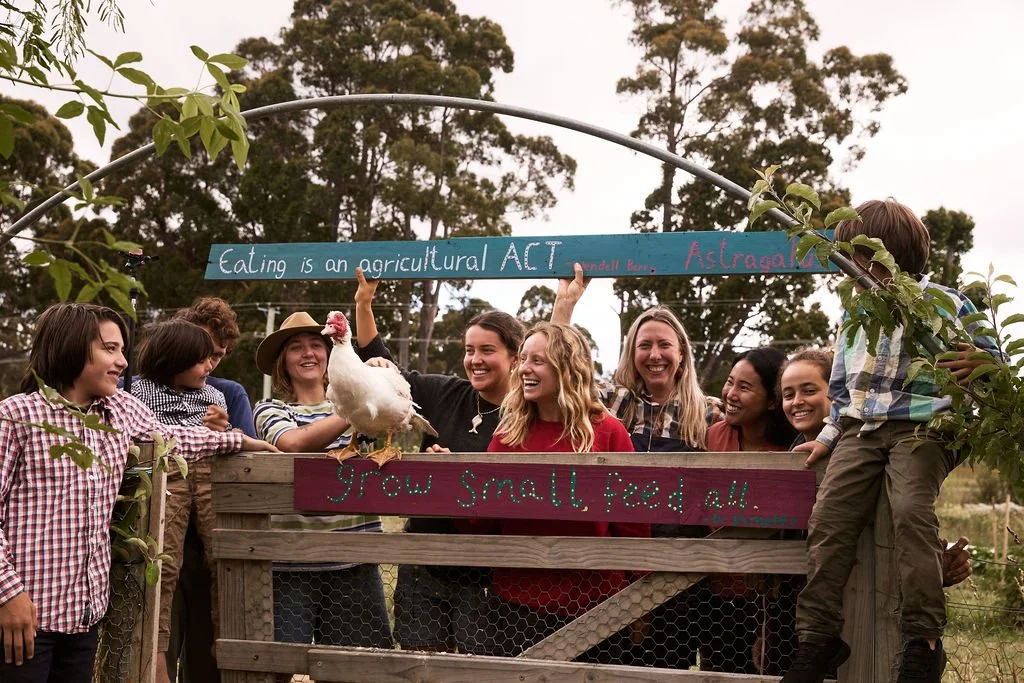
ROW SMALL, FEED ALL — endorsed by Simon the duck.
It’s time to back what works: local growers and fishers, real markets, cold rooms and food hubs, local procurement for schools and hospitals, clear water limits, and thousands of practical jobs that keep money circulating in Tasmania.
Sources:
Food System Horizons, Fact Sheet 3: Food policy in Australia (Feb 2024; cites University of Sydney database scale, 7,000+ policies)
University of Sydney, Law School, Australian Local Food System Policy Database (policy database, 7,000+ local government policies referencing food)
University of Tasmania, Institute for Marine and Antarctic Studies (IMAS), 2022–23 Social Economic Analysis Contributions snapshot (Nov 2025; salmonid aquaculture employment ~6,935; total gross value added ~$1,154m)
NRE Tasmania, Tasmanian Agri Food ScoreCard 2022–23 ($5.39b food spend; $1.97b sourced from outside Tasmania; $1.84b interstate; $134m overseas; ~36.5% outside; ~11x produced vs consumed)
NRE Tasmania, Tasmanian Salmon Industry Plan – Cost Recovery (2024–25 levy estimate $9.6m; $3,310/ha; 2,905ha)
NRE Tasmania, Performance Statement 2023–24 – Salmon Cost Recovery Program (2023–24 management costs ~$10.17m; 2024–25 budget ~$10.37m)
DCCEEW FOI release material on Macquarie Harbour (as reproduced in FOI documents – Macquarie Harbour) (Commonwealth $37.5m since June 2022; Tasmania $5.13m since 2014)
Fisheries and Oceans Canada, BC salmon aquaculture transition policy / statements (open net pen salmon aquaculture in coastal BC to end by 30 June 2029)
Regen Era Design Studio, Grow Small, Feed All policy proposal (campaign architecture: $600m over 10 years; $450m farm renewal grants; $150m coordination and assurance)