When the Field Can Breathe Again
A Reflection on Healing, Protection, and the Work Beneath Struggle
I am writing from a place that seeks healing rather than resolution, softness rather than certainty, and depth rather than speed. This is not a response to a single event, movement, or ideology, but an offering into a wider field that feels strained, vigilant, and tired, as though something essential has been held for too long without rest.
Under the Cancer full moon of January, 3rd 2026, a moon cycle moment traditionally associated with completion, illumination, and the possibility of release, I became aware of how rarely we allow the work of protection to soften. Cancer, as an archetypal force, carries the Mother principle, the instinct to shelter life, to hold continuity, to keep what is vulnerable safe. This work is sacred and necessary. Yet even the Mother must rest, and when she cannot, when holding becomes permanent rather than responsive, protection begins to change its nature.
What I sense in many parts of our collective life is not a lack of care, but an overextension of it. A field shaped by years of crisis, injustice, grief, and unresolved trauma has learned to stay alert, to stay ready, to stay morally awake at all times. Strength in this context is understandable, and in many moments it is essential. There are real harms that require resistance, real imbalances that demand response. And my reflection here does not diminish that reality.
When intensity becomes constant and vigilance is never allowed to stand down, something subtle and vital begins to erode. The body tightens and the nervous system remains braced. Relational warmth becomes harder to access, there is a tendency for complexity to feel unsafe. Over time, even the most well intentioned movements risk becoming brittle, not because they lack justice, but because they have lost the conditions that allow justice to remain humane. This is the unseen phenomenon beneath so much ongoing conflict. Not only the persistence of power imbalance or structural harm, but the gradual hardening of the soul that occurs when care becomes vigilance and holding becomes identity. When protection is required to function without pause, it can no longer listen, soften, or adapt. What began as love becomes duty, and what began as care becomes constraint.
At the same time, Venus is moving through her underworld phase, a symbolic descent in which value withdraws from visibility and performance and is reworked internally. In this space, worth is no longer proven through display, alignment, or being seen to care in the right way. Instead, value is stripped back to what is real, quiet, and enduring. Venus underworld energy does not ask us to love less or act less, but to release the need to perform our care in order for it to count.
Together, these two movements offer a gentle correction. The Cancer full moon reminds us that holding is an act, not an identity, and that even the Mother must rest. Venus in the underworld reminds us that worth does not need to be demonstrated to be real. When protection can soften and value can rest from performance, something in the field begins to breathe again.
This understanding is not new. Older cultures, and older circles of women, once tended society and futures through continuity, relationship, and embodied care rather than escalation alone. They worked slowly, often invisibly, holding the relational and emotional ecology that allowed communities to survive conflict without losing their humanity. Much of this work has been forgotten or dismissed in a world that is now based in fast urban, hyper-mobile and digital-strong settings and privileges speed, scale, and confrontation, yet its absence is now being felt.
My own role, as I understand it, is not to replace resistance or diminish the necessity of front line action, but to tend this often unseen layer beneath it. I describe this work as ecological mind feminism, a pluralistic feminist practice that attends to the relational, embodied, and emotional conditions through which struggle is carried. This includes nervous systems under strain, patterns of care and emotional labour, grief that has not yet been metabolised, and relationships that require warmth as much as clarity.
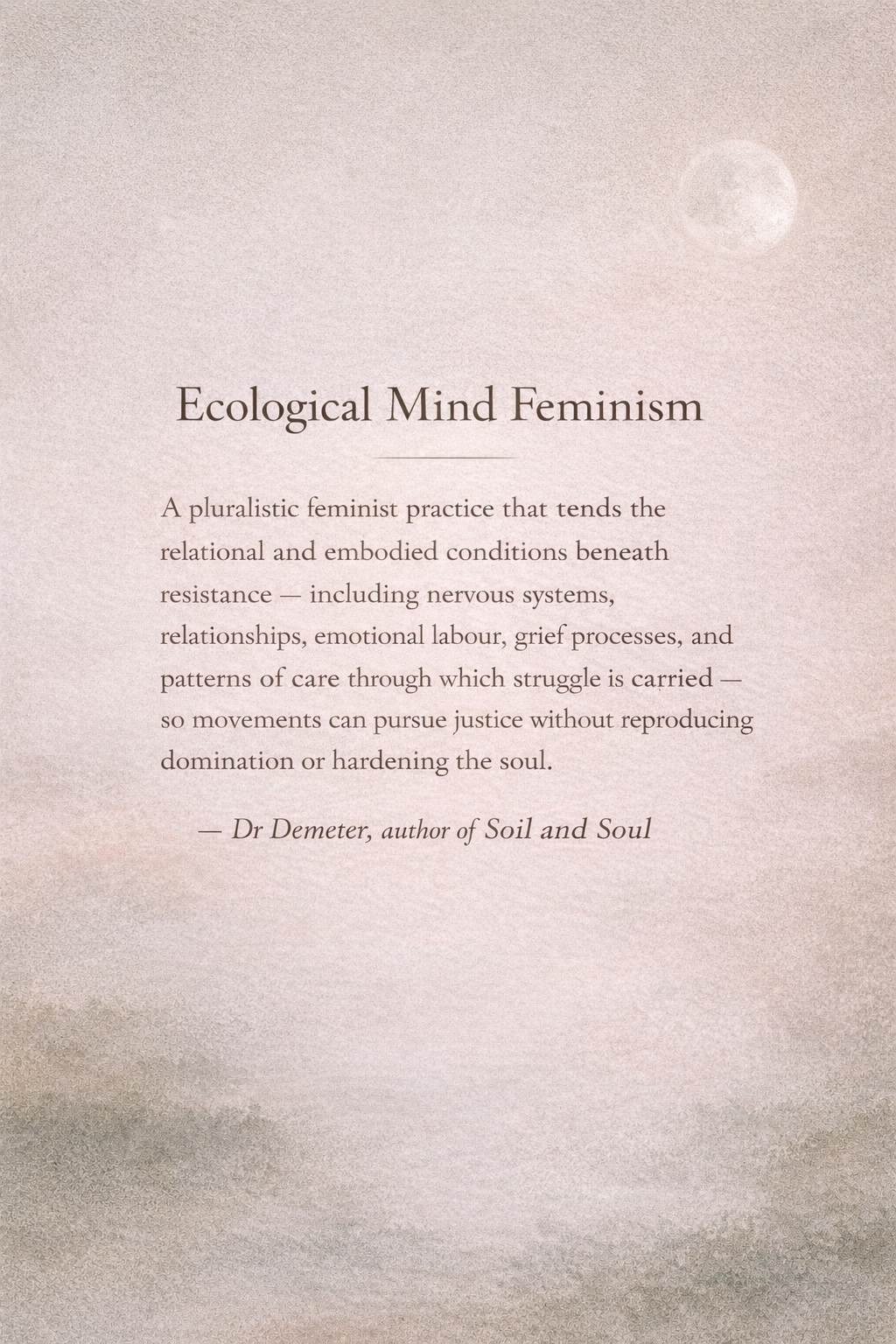
This is not softness as retreat. It is softness as endurance. It is the work of ensuring that protection does not harden into domination, that care does not collapse into exhaustion, and that movements seeking justice do not lose the very humanity they are trying to protect. Healing into the field does not mean avoiding conflict or bypassing pain. It means creating spaces where protection can rest without disappearing, where care does not need to be proven, and where the heart can remain open without being exposed. In these spaces, something essential is restored: the capacity to remain human together, even in the presence of difference, disagreement, and struggle.
This is the offering I wish to make in this moon and venus moment, not a solution or a stance, but a remembering. That justice is not only something we pursue, but something we carry. And how we carry it shapes what becomes possible next. May this reflection soften what has been held too tightly, restore warmth where vigilance has dominated, and contribute, in its own quiet way, to a field that is capable of healing as well as change.
With Love and Con Viv, Dr Demeter