

“We weave ideas, scribe forward, align with life and create connection.”
— Dr Demeter | Emily Samuels-Ballantyne
Covering topics on Foundational Economics, Convivial Governance, Anthroposophic Philosophy & Everyday Regeneration in Tasmania
Overview
The Island Almanac is a living compendium of stories, tools and place-based examples that weave together foundational economics, anthroposophic wisdom and the rhythms of everyday life. Rooted in the soils of Tasmania and flowering from Magical Farm Tasmania. Across its pages you’ll find:
Practical essays on redirecting public and private wealth into community resilience
Anthroposophical reflections on seasonal rhythms, ritual and soul-led innovation
Tasmanian case studies from coastal hamlets to mountain valleys
Project spotlights on island-wide initiatives, from seed libraries to solar co-ops.
Living Architecture: A dynamic framework of interconnected practices, food, housing, energy, governance, culture, activism and economics that grows, adapts and breathes like an ecosystem, rather than standing as static policy or infrastructure. These seven pillars form the Living Architecture of Regen Era Design Studio & The Island Almanac: integrating heart, head & hands to power a truly regenerative future.
Food, Plants and Planets
Housing and Natural Building
Energy
Community Life, Learning & Culture
Sacred Activism
Convivial Governance
Regenerative Economic Design.

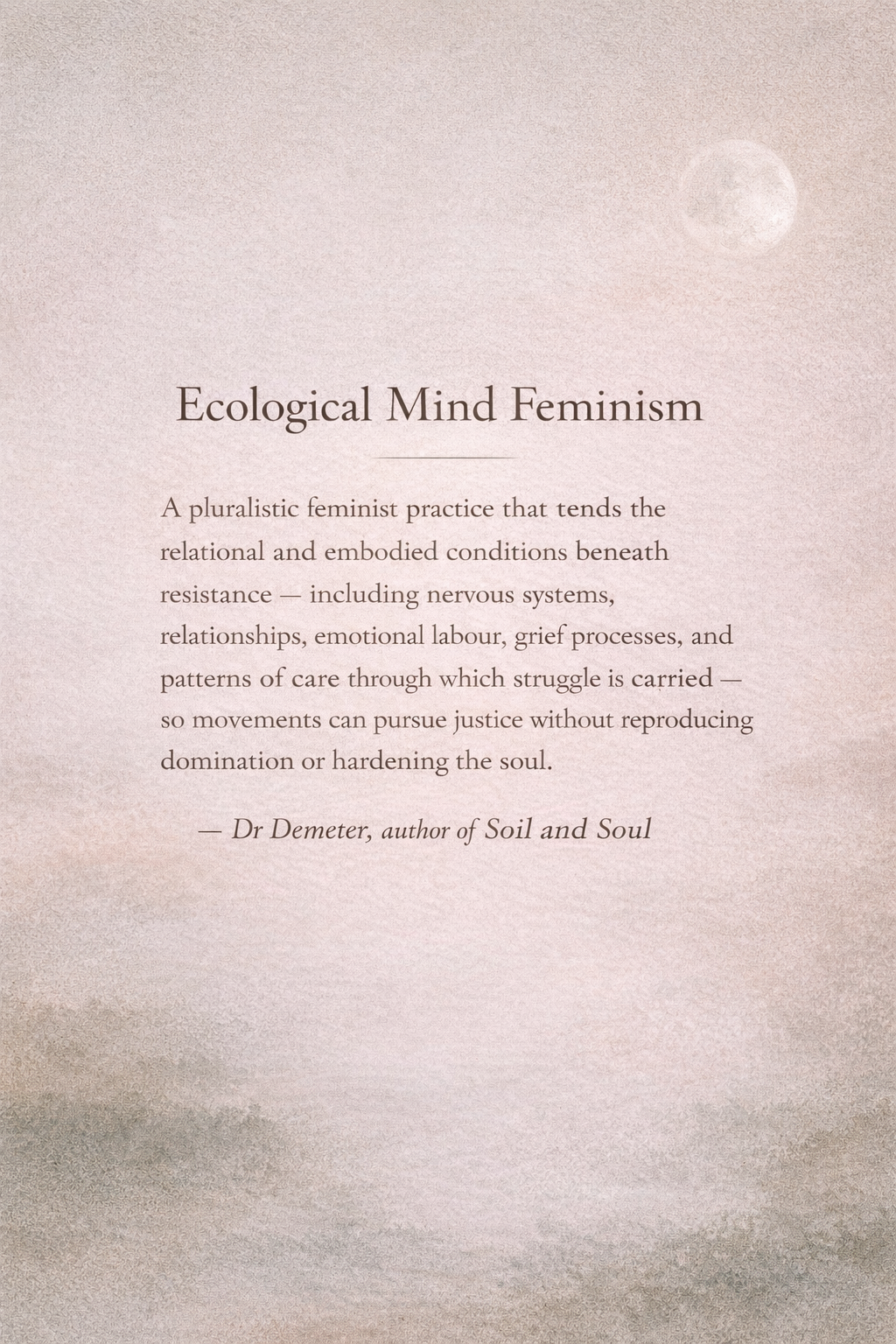
When the Field Can Breathe Again
This article reflects on the unseen costs of constant vigilance in contemporary movements for justice, exploring how prolonged protection can harden the soul and erode relational warmth. Drawing on the symbolism of the Cancer full moon and Venus in the underworld, it offers ecological mind feminism as a pluralistic practice that tends the relational and embodied conditions beneath resistance, supporting forms of activism that remain strong without losing their humanity.
Cultural Emergence at Magical Farm Tasmania Sunday January 18th 2026
Cultural Emergence at Magical Farm on Sunday 18th Jan 2026 is an invitation into a different kind of change-making, one that treats culture as a living system shaped by what we practice repeatedly, not just what we believe or argue about. Blending social permaculture, breathwork, forest therapy, and practical life-design tools, the workshop offers a grounded day of re-patterning attention toward what grows trust, resilience, and real belonging. It’s for anyone feeling the strain of our times and craving a space that can hold complexity without hardening, where ecological intelligence becomes embodied, relational, and replicable, and where hope is practiced into existence together.

Ecological Mind Activism
This article challenges the dominant narrative of environmental activism by reframing the krill crisis through the deeper lens of food systems, ecological identity and regenerative community practice. It argues that industrial krill extraction is not only an oceanic tragedy, but a symptom of depleted soils, hollow food cultures and lifestyles disconnected from place. Drawing on Tasmanian case studies and place-based scenarios, the piece offers an imaginal pathway where nutrient-dense local foods, herbal traditions, community renewal schemes and land-sea reciprocity dissolve the demand for krill-based supplements altogether.
The article critiques the performative tendencies of modern activism: the adrenaline, spectacle and “thrill to save krill” and calls for a new paradigm grounded in slowness, competence and systemic cultivation. Integrating Freya Matthews’ ecological self theory with the author’s Convivial Self theory, it introduces Ecological Mind Activism: an approach where activists embody the ecological mind while practicing the convivial skills needed to regenerate community systems, redirect public funds toward life-enhancing projects and rebuild local food autonomy.
Through the work of Regen Era Design Studio, the article demonstrates how these principles can be applied in real places, offering practical tools for moving beyond resistance into renewal. Ultimately, it argues that environmental action must evolve from fighting extraction to cultivating the cultural and ecological conditions that render extraction unnecessary, inviting a shift from performance to praxis, from urgency to attunement, and from crisis to regeneration.

The Fault Line Series: What Is Your Business Model?
In this sharp and grounded essay, Dr. Demeter (Emily Samuels-Ballantyne) turns the common bureaucratic question, “What is your business model?” back on local government itself. Drawing on two decades of lived experience as a community builder, policy designer, and regenerative farmer, she critiques the top-heavy policy pipelines that reduce care to documents and engagement to output metrics. With references to institutional theorists like Guy Debord, Ivan Illich, Henri Lefebvre, and Helena Norberg-Hodge, the essay explores how public funding is often diverted away from tangible outcomes into layers of abstraction and consultancy. Through the lens of her own project, the Huon Valley Food Hub, Demeter offers an alternative approach: the redirection of the brief toward grounded, co-created, and regenerative public work. The piece concludes with a call for a new kind of public service, one rooted in care, participation, and a living systems worldview.

Why I Write in the Island almanac
Synopsis:
This article explores why Dr. Emily Samuels Ballantyne (Dr Demeter) writes the Island Almanac as a living design journal, a poetic manifesto, and a tool for transition. Drawing on the wisdom of Rudolf Steiner, Arturo Escobar, and Tyson Yunkaporta, Emily outlines how scenario-based thinking and design-led prototypes can help regenerate our core systems: food, housing, energy, sacred activism, convivial governance, community life, and economics. Writing becomes a spiritual and strategic act rooted in land, rigour, and imagination inviting others to co-create a pluriversal future aligned with life.