We Are All Designers: The Case for Life Systems Literacy
Design has long been understood as a professional discipline, practised within studios, universities and consultancies, shaping products, services, policies and environments. The design professions matter deeply. They influence how economies function, how cities are structured, how resources move.
Yet design did not begin with institutions. The first tools were designed, as too was language. Markets and governance systems were designed. The supermarket, the local market, the digital platform, each of these is a designed architecture of economic flow. These structures shape how money circulates, how food travels, how culture gathers, and how power concentrates or distributes.
We are all already designers. The question is whether we understand the living systems within which we are designing.
From an anthroposophic perspective, the human being is not separate from the social and ecological organism but an organ within it. Our daily decisions, what we eat, where we purchase, how we spend, how we organise time, how we participate in civic life are a pattern of our reality. Economic flow reflects or mirrors ecological flow. When value moves through distant, centralised supply chains it is our farmland, landscapes and communities that thin. When it circulates through local markets and small farms, relationships strengthen and resilience thickens.
Food is not simply nutrition it is in fact formative. It shapes the body; the body shapes perception; perception shapes culture and design. A culture that eats together generates cohesion. A region that grows food regeneratively restores soil, biodiversity and water cycles. Healthy land produces healthy food; healthy food supports healthy bodies; healthy bodies enable clearer perception; clearer perception supports wiser design. The loop is ecological, cultural and economic at once.
Localised, biodynamic food systems are therefore not nostalgic gestures, they are perceptual and civic infrastructure. As both farmer and design theorist, I have come to articulate this through Con Viv: convivial living systems design. Con Viv does not reject professional design; it deepens it. It asks designers to consider metabolism alongside materiality, governance alongside geometry, soil alongside system and policy. It recognises that everyday citizens are co-designers of economic and ecological futures through their habits and participation.
Grow Small, Feed All campaign emerged as a structural application of this thinking, redirecting economic flows toward nourishment, decentralising value, strengthening localised food economies and restoring dignity to producers. It is not a campaign alone; it is a design proposition at regional scale, in Tasmania and possibly for other places too!?
Living Earth College is now emerging from this work as a translocal education platform dedicated to life systems literacy. Its premise is simple: soil processes, cooperative economics, phenomenological observation, real world place-based food projects coming to life as prototypes for sharing, co-design of policy and cultural practice must become foundational within design education, not peripheral.
The professional designer has a critical role to play. So too does the student, the policymaker, the farmer and the household. If life systems literacy were embedded across disciplines and daily life, design would shift from extraction toward participation. We are already shaping the future. As we are all designers, the invitation is to design consciously, in service of living systems.
Dr Demeter / Emily
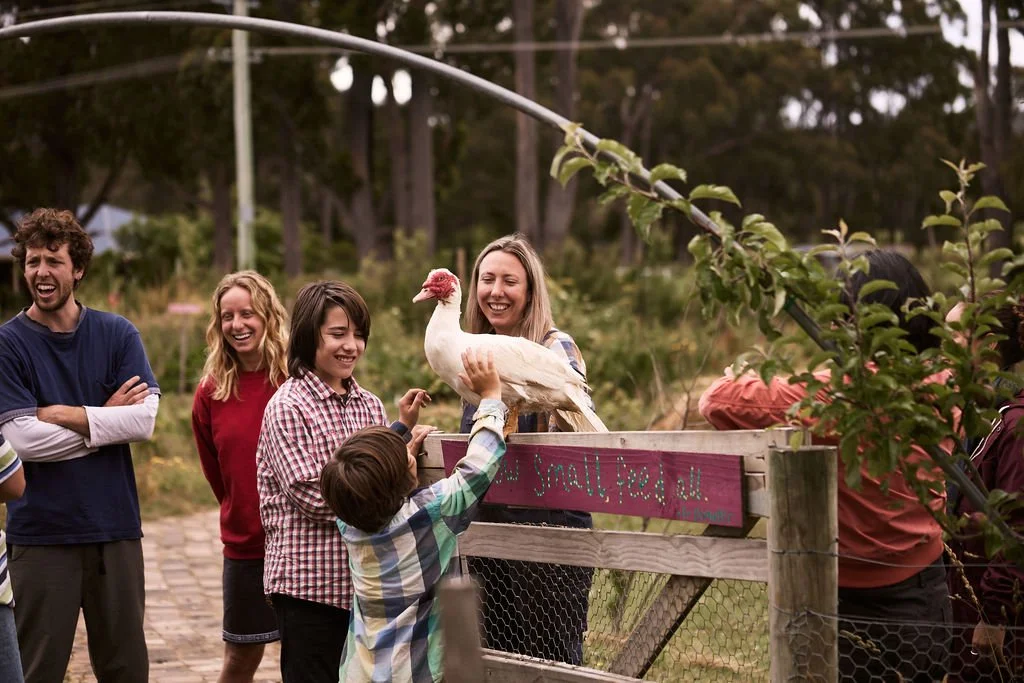
Photography by Ness Vanderburgh, Grow Small Feed All Campaign, seeded from Magical Farm Tasmania